
The Remarkable Journey from Egg to Elder
A Promise Held in a Shell 🥚
It all begins with a promise. A smooth, pale, or sometimes speckled object, cradled carefully on rocky ground or balanced precariously on a pair of weathered feet. An egg. It seems so simple, yet within its fragile shell lies the entire future of a penguin—a blueprint for survival honed over millions of years. This is not just the start of a life; it’s the first chapter in an epic saga of endurance, a journey that will take this tiny, unborn creature from a state of complete dependence to becoming a master of both land and sea. The question, “How long do penguins live?” can’t be answered with a simple number. The real answer is a story, and it starts right here.
Chapter 1: The First Breath – From Chick to Crèche
After a grueling incubation period, which can range from about a month for Little Blue Penguins to over 65 days for Emperor Penguins, the first crack appears. The chick, using a temporary “egg tooth” on the tip of its beak, begins the exhausting process of “pipping.”
The Fluffy Stage: A World of Dependence
Emerging wet and exhausted, the chick is a tiny, vulnerable creature, covered in a soft layer of downy feathers. These feathers are excellent for insulation but are not waterproof, meaning the chick is entirely land-bound and dependent on its parents for two crucial things: warmth and food.
- Constant Care: In the early days, parents take turns guarding the chick and foraging for food. They regurgitate a nutrient-rich “fish smoothie” of krill, squid, or fish for the chick. A 2024 study from Otago University in New Zealand highlighted that the composition of this regurgitated food changes as the chick grows, perfectly matching its developmental needs.
- Vulnerability: This stage is fraught with peril. In the Antarctic, a moment of inattention can lead to a chick freezing to death or being snatched by an opportunistic skua. As we’ve explored in our post on penguin predators, the sky is a constant threat.
The Crèche: Safety in Numbers
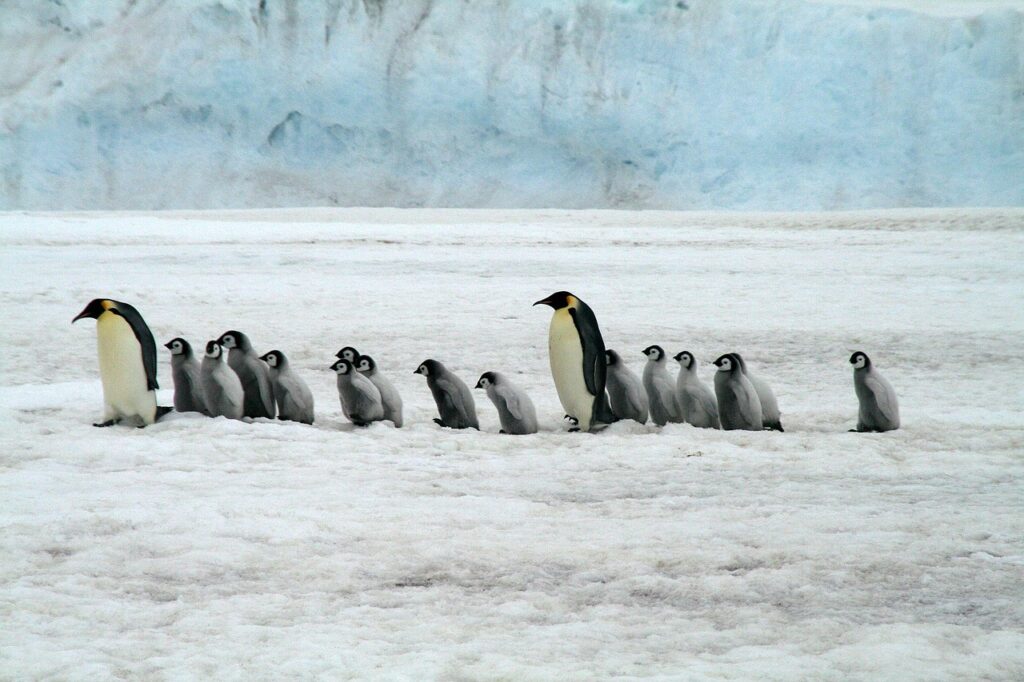
As the chicks grow larger and more demanding, the parents must both go to sea to find enough food. It is at this point that one of the most charming spectacles of the penguin world occurs: the formation of a crèche (a “penguin daycare”).
Chicks huddle together in large groups, sometimes numbering in the thousands. This strategy offers several key advantages:
- Thermoregulation: Huddling together conserves a massive amount of body heat.
- Defense: A large group provides collective defense against predators like giant petrels and skuas. It’s much harder for a predator to single out a chick from a swirling mass of fluffy bodies.
Scientists believe the crèche is not just a passive huddle. According to the Woods Hole Oceanographic Institution, chicks can recognize their parents’ unique calls from hundreds of others, ensuring they get fed by the right adults when they return from the sea.
Chapter 2: The Big Leap – Fledging and Juvenile Life
After several months of growth, the fluffy down is replaced by a sleek set of waterproof juvenile feathers. This is the moment of fledging—the transition from land-dweller to mariner. It’s the penguin equivalent of leaving home for the first time, and it’s arguably the most dangerous period of their lives.
The First Swim: A World of New Dangers
The fledgling penguin must take its first plunge into the ocean, a world it has never known. It must learn to swim, hunt, and, most importantly, evade a whole new suite of marine predators like leopard seals and sea lions.
- High Mortality: The first year at sea is a brutal filter. Survival rates for juvenile penguins are tragically low. The WWF estimates that for many species, fewer than 50% of fledglings survive their first year. They are inexperienced hunters and are prime targets for predators.
- A Period of Wandering: During their juvenile years, which can last from one to several years depending on the species, young penguins are nomadic. They travel vast distances, exploring the ocean and honing their survival skills. A 2023 satellite tracking study by the British Antarctic Survey (BAS) revealed that juvenile King Penguins can travel thousands of kilometers from their birth colony, a true oceanic odyssey.
Chapter 3: The Return – Adulthood and the Cycle Renewed
If a penguin survives its perilous juvenile years, it will eventually feel an ancient, irresistible pull to return to the place of its birth. Upon reaching sexual maturity (typically between 3 and 8 years of age), it will seek a mate and begin the cycle anew.
So, How Long Do They Live?
This is where the story comes full circle. A penguin’s lifespan in the wild is highly variable, depending on species, location, and a great deal of luck.
- Smaller Species: Little Blue Penguins, the smallest species, often live for 6 to 10 years.
- Medium-Sized Species: Adélie, Gentoo, and Chinstrap penguins typically live for 15 to 20 years.
- Larger Species: The giants of the penguin world, King and Emperor penguins, can live for 20 years or more in the wild, with some individuals in protected environments reaching even older ages. The IUCN notes that accurate lifespan data is hard to collect, as tracking an individual penguin for its entire life in the harsh polar environment is incredibly challenging.
Factors That Cut Life Short
An adult penguin’s life is a constant negotiation with risk.
- Predation: Even as experienced adults, the threat of an orca or leopard seal is ever-present.
- Starvation: The biggest killer. Climate change is altering ocean currents and sea ice, making food sources like krill and fish less reliable. A failed hunting season can mean death.
- Disease: Outbreaks of avian cholera and other diseases can devastate a dense colony.
- Catastrophic Molt: Once a year, penguins must replace all their feathers at once. During this “catastrophic molt,” they are not waterproof and cannot go to sea to hunt. They must survive on their fat reserves for several weeks. If they haven’t built up enough fat, they will starve on land.
The Long Arc of a Penguin’s Life 💡
The journey from a fragile egg to a 20-year-old veteran of the Southern Ocean is nothing short of miraculous. It’s a story written in chapters of extreme cold, fierce loyalty, breathtaking courage, and heartbreaking loss. A penguin’s life is not measured merely in years, but in the number of successful journeys to the sea, the number of chicks raised, and the number of seasons survived against all odds.
When we see an older penguin, with a few scars on its flippers and a wisdom in its eyes, we are looking at a true champion of survival. It has outwitted leopard seals, navigated thousands of miles of open ocean, endured blinding blizzards, and faithfully returned, time and again, to bring forth the next generation. Their lives are a powerful, poignant reminder of the resilience of life in the planet’s most extreme corners, and a call to action to protect the fragile world that allows their incredible story to continue. 🐧❤️